Next-Generation Bioreactor System

CRISPR-Modified Chicken PGCs for High-Yield Recombinant Protein Production

Revolutionizing protein production with avian biotechnology - producing valuable biologics at a fraction of current costs

Explore the Opportunity

Built on CRISPR-Modified Chicken PGCs

Primordial Germ Cells are the foundation of our innovative bioreactor system
Primordial Germ Cells

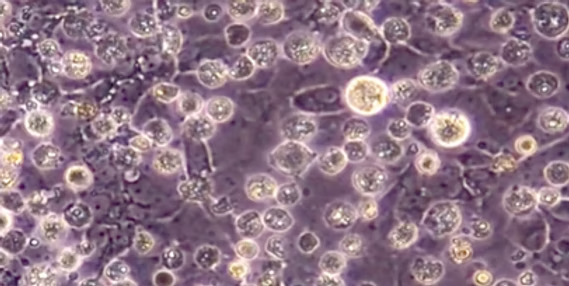
Primordial Germ Cells (PGCs)

Primary undifferentiated stem cells that differentiate towards gametes: spermatozoa or oocytes. PGCs serve as tools for storing high-quality genetic resources, wildlife conservation, and expression of recombinant proteins.
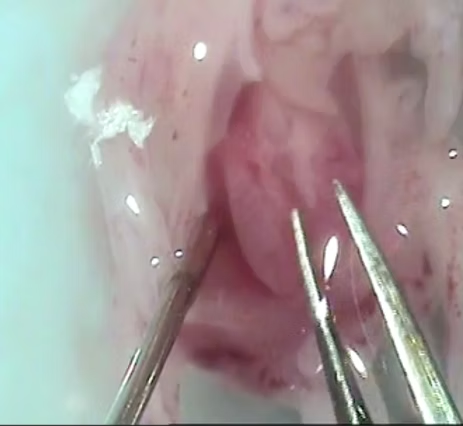
Gene Editing Process

Gene Editing Capability

CRISPR technology enables precise genetic modifications in chicken PGCs, allowing targeted insertion of genes for valuable recombinant protein expression directly in egg production.
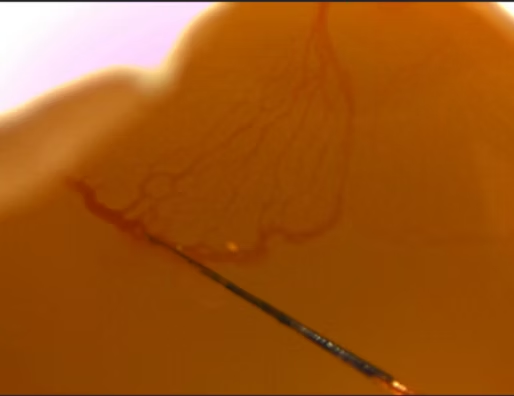
Bioreactor System

Scalable Bioreactor

Each gene-edited chicken becomes a living bioreactor, producing designer eggs containing high-quality recombinant proteins. Simple, efficient, and infinitely scalable.
Massive Market Opportunity

The global recombinant protein market is experiencing explosive growth

$2.4B+
Global Market Size
14%
Annual Growth Rate
90%
Cost Reduction Potential
Production Scalability

Our Technology Platform

Three integrated approaches deliver reliable, scalable protein production

1
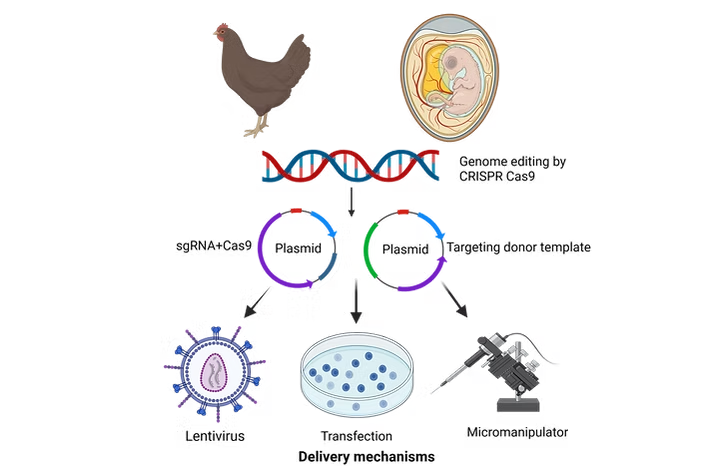
CRISPR Delivery Mechanism

CRISPR Delivery Platform

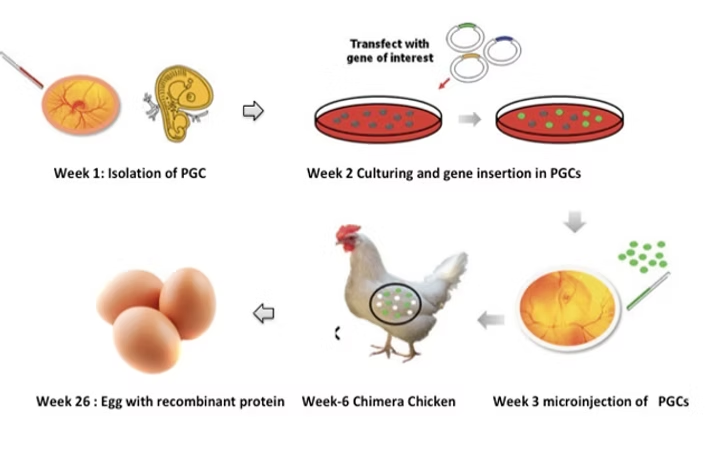
We identify target DNA sequences and design plasmids carrying Cas9 and guide RNA. Delivery through viral vectors, transfection, or direct microinjection produces gene-edited chicken cell lines with precision.

2
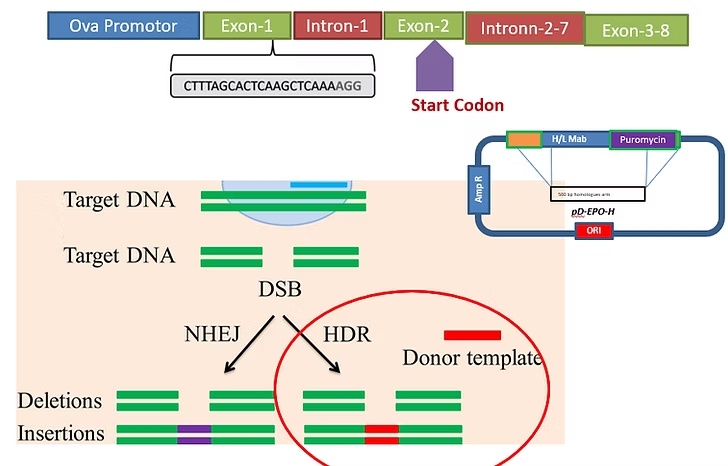
Knock-in Generation Process

Knock-in Generation

CRISPR makes precise cuts in the bird's DNA while providing matching donor templates. The cell naturally repairs by copying new genes into its genome, enabling accurate and stable transgene expression.

3
Bioreactor Production System

Bioreactor Production

Edited germ cells are placed into embryos, growing chickens that lay eggs containing desired recombinant proteins. Each egg becomes a simple, scalable production unit for valuable biologics.

Proven Production Results

Real-world validation of our technology platform

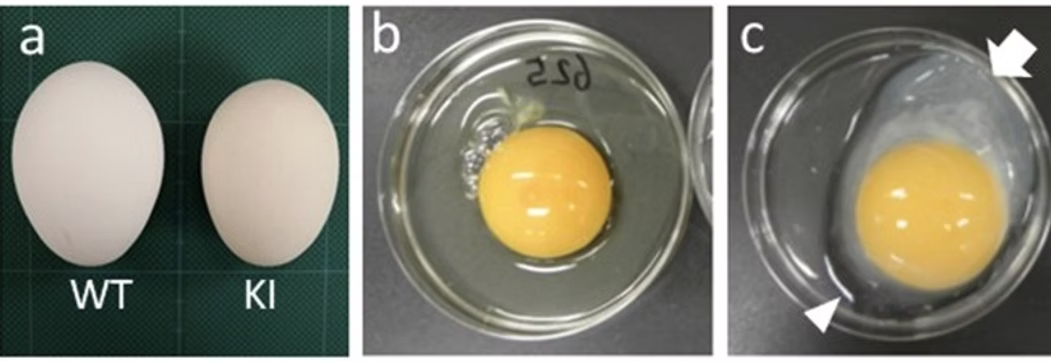
Wild-Type vs. Knock-In Egg Production

Reference: Oishi, I., Yoshii, K., Miyahara, D. et al. Efficient production of human interferon beta in the white of eggs from ovalbumin gene-targeted hens. Sci Rep 8, 10203 (2018).

Production Comparison Data

Wild-Type (WT) Eggs

  • Normal size and appearance
  • Clear, uniform albumen composition
  • Standard viscosity throughout
  • Typical egg-white structure

Knock-In (KI) Eggs

  • Reduced size due to protein loading
  • Visibly altered egg-white structure
  • Watery regions with gelatinous clumps
  • High recombinant protein content
  • Modified viscosity from protein expression

Key Insight: The altered albumen structure in KI eggs confirms successful high-level recombinant protein secretion in the oviduct, validating our approach for commercial-scale production.

Meet the Team

World-class researchers and scientists driving innovation in avian biotechnology

Dr. Debasis Nayak
Dr. Debasis Nayak
MVSc, PhD | Associate Professor
Department of Biological Sciences
Indian Institute of Science Education & Research, Bhopal
Dr. Adnan Naim
Dr. Adnan Naim
Principal Investigator
KIIT-TBI
KIIT University, Bhubaneswar
Akanksha Chaturvedi
Akanksha Chaturvedi
Scientist D
BRIC-NCCS
Arjun Sharma
Arjun Sharma
PhD Scholar
Indian Institute of Science Education & Research, Bhopal
Sanket Kumar Ray
Sanket Kumar Ray
Project JRF
Indian Institute of Science Education & Research, Bhopal
Aakash Adhya
Aakash Adhya
BS-MS Biological Sciences
Indian Institute of Science Education & Research, Bhopal
Navonil Chakraborty
Navonil Chakraborty
BS-MS Biological Sciences
Indian Institute of Science Education & Research, Bhopal

Protected Innovation

Our technology is secured by intellectual property protection

Patent Application Filed

Primordial Germ Cells conservation of Indian Aseel and Kadaknath chickens, via single-host double Chimera technology

Application No. 202131001733 • Filed January 13, 2021